

Gas Station Heroin: Two Different Drugs Are Sharing One Name
Kemal Whyte"Gas station heroin" is a nickname for tianeptine. That is the answer most people are looking for when they type those three words, and if it is the only thing you take from this page, take it. Tianeptine is a synthetic drug. It is licensed as an antidepressant in some other countries, it is not approved by the Food and Drug Administration for any medical use here, and it turns up on American shop counters under names like Zaza, Tianaa, Pegasus, TD Red and Neptune's Fix. It is not kratom. It is not a plant at all.
The trouble is that the phrase did not stay where it was put.
The same three words have also been attached, in headlines and in ordinary conversation, to concentrated 7-hydroxymitragynine products that sit on the same counter, sometimes the same shelf. Those are a different thing again, with a different chemistry and a different regulatory story. If you searched this phrase because you are worried about a person, you may be looking for one of two substances, and a fair amount of what you will read has not decided which one it means.
I should say who is writing this. I sell kratom through other brands, so I am not a neutral party. This is on my own site, which sells nothing, for a reason I set out below.
What the phrase actually points at
The clearest statement of where the nickname comes from is a letter FDA published to health care professionals on 8 May 2025, headed "New 'Gas Station Heroin' Tianeptine Product Trend". The operative sentence is not complicated. Tianeptine, it says, is "often called 'gas station heroin' because of its availability in gas station stores", and it is not approved by FDA for any use.
The rest of that letter explains the mechanism rather than the vibe. Tianeptine is a full mu-opioid receptor agonist. In countries where it is an approved medicine the labelled dose for depression is 12.5 mg three times a day, and FDA writes that case reports describe American consumers taking daily doses on the order of 1.3 to 250 times that, which at the top is ten grams a day of a drug nobody here is supervising. Stopping abruptly can produce withdrawal that looks like coming off opioids. Reported adverse events include agitation, confusion, coma, respiratory depression and death.
Two details in it matter more than any of the numbers, and I have not seen either in the coverage. Tianeptine may not show up on a routine drug screening panel, which means a hospital can be looking straight at a case and not see it. And a 2024 cluster of illnesses in New Jersey was tied to a product called Neptune's Fix, which on analysis contained tianeptine and synthetic cannabinoid receptor agonists together. Whatever anyone thought they were buying, that is not what was in the bottle.
That is the drug the nickname belongs to.
How 7-OH ended up wearing the same name
The link between the two was not invented out of nothing, and I want to be fair about that. The easy version of this column blames journalists and stops.
FDA's own people say it. On the agency's FDA Direct podcast episode on 7-OH, content current as of 1 August 2025, two officials work through it mid-conversation about vape shops. One mentions the tianeptine letter, calls tianeptine "basically what's called gas station heroin", then adds: "Although of course 7-OH is also called gas station heroin. But that's sort of its own drug." The other agrees, and describes tianeptine as "a very different but similar type drug that's widely available in the same locations that you'll find 7-OH."
Read that carefully. Two FDA officials acknowledge in the same breath that the nickname has spread to a second substance, then correct themselves to say the two are different drugs. That instinct goes missing downstream.
What regulators have not done is adopt the phrase. It appears nowhere in DEA's notice of intent on 7-OH, nowhere in FDA's scientific report, nowhere in the July 2025 announcement and nowhere on the 7-OH information hub. So when you read that regulators call these products gas station heroin, that is not true, and it is not a small error. A nickname is much easier to dismiss than a chemical threshold.
The press is where the collapse happened. NBC News ran a piece on 17 August 2024 headed "'Gas-station heroin' targeted in crackdowns by states and cities", whose opening summary describes kratom as "sometimes referred to as 'gas station heroin'". Not 7-OH. Kratom, the leaf, the whole category. That ran a year before FDA's tianeptine letter and two years before DEA filed anything, and the phrase was already doing work it was never built for. It still is: an August 2026 Forbes column runs it across four numbered categories, with kratom, 7-OH and tianeptine all filed under the first one.
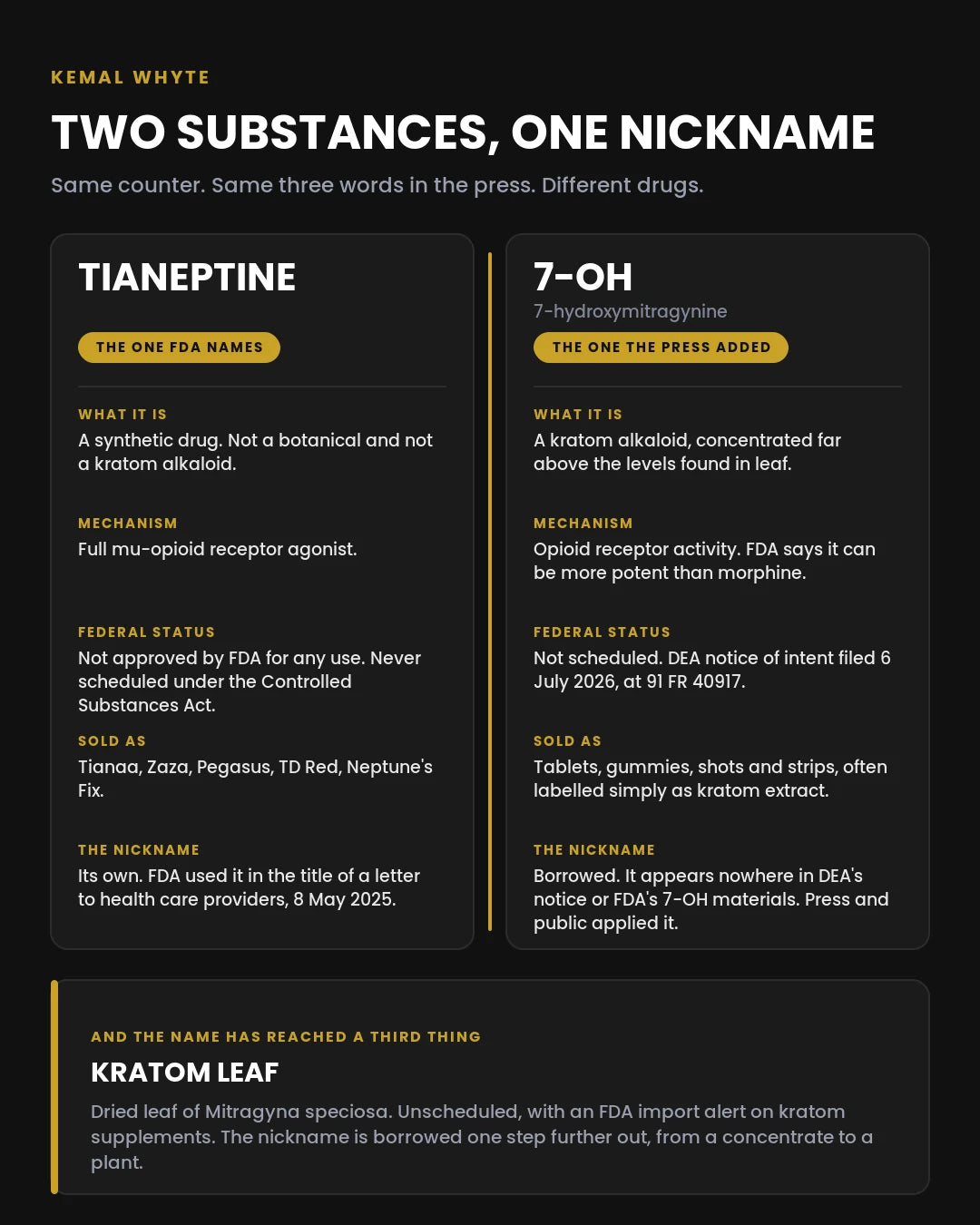
Three things, side by side
Here it is laid out flat, because I have not seen it done anywhere else.
| Tianeptine | 7-OH, concentrated | Kratom leaf | |
|---|---|---|---|
| What it is | A synthetic drug, licensed abroad as an atypical antidepressant | An alkaloid concentrated far above leaf levels, by synthesis or processing | Dried leaf of Mitragyna speciosa |
| Nickname | Earned it. FDA uses it in a letter title | Borrowed it, from press and public, not from any agency | Borrowed again, one step further out |
| Federal status | Unapproved for any medical use, unscheduled. Schedule I proposed 8 July 2026 | Unscheduled. Two notices of intent filed 1 July 2026, published 6 July | Unscheduled. FDA import alert on supplements |
| Sold as | Tianaa, Zaza, Pegasus, TD Red, Neptune's Fix | Tablets, gummies, shots, strips, often labelled simply as kratom extract | Powder, capsules, leaf |
Two of those three federal-status cells moved two days apart: the 7-OH notices on 6 July 2026, DEA's proposal to schedule tianeptine on 8 July. The middle column is my industry's responsibility, and it is where the rest of this piece goes.
What the numbers say, and what they do not
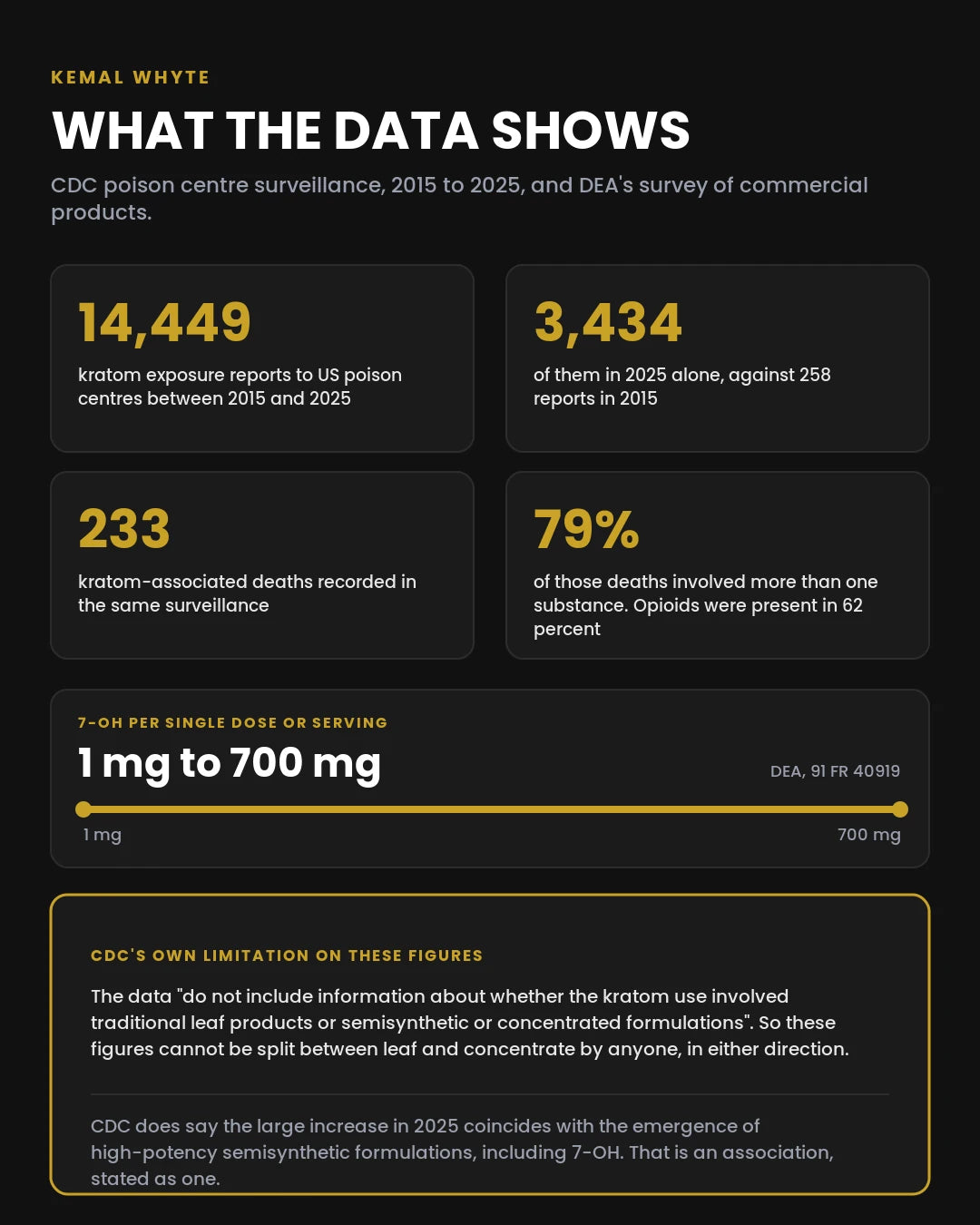
DEA's notice of intent on 7-OH, published at 91 FR 40917 on 6 July 2026, is the document to read if you want to know what the federal government is actually proposing. It would reach material containing more than 0.050% 7-OH by weight, or more than 1.00 mg of 7-OH in the article, and it names two routes in: synthetic material, and plant material that has been further processed into "extracts, concentrates, processed edibles, or pressed pills".
Three findings inside it deserve more attention than the headline. DEA describes these products as "often characterized by ambiguous dosages and misleading marketing, frequently being labeled as 'natural M. speciosa extracts'". It records dose per serving ranging from 1 mg to 700 mg across the products it examined, a seven hundred fold spread inside one category on one shelf. And it says essential information about purity, identity, quantity and long-term safety remains unknown.
Seven hundred fold. Two packets can look identical, sit next to each other, and differ by that much.
On potency, the numbers in circulation need sorting out, because they measure different things. FDA Commissioner Marty Makary said on 29 July 2025 that "7-OH is an opioid that can be more potent than morphine". FDA's scientific report puts respiratory depression at more than three-fold the potency of morphine. The figure of thirteen times morphine, which has travelled a very long way, is in that same report: it traces to a 2004 paper by Matsumoto and colleagues and describes one in vitro assay on isolated guinea pig tissue, not the drug in general. Minnesota's and Texas's health departments carry it too. DEA's notice does not. If you quote the number, quote the assay with it.
Then there is the surveillance data. CDC published a report in Morbidity and Mortality Weekly Report on 26 March 2026 covering kratom-related reports to poison centres from 2015 to 2025: 14,449 exposure reports over the period, 3,434 of them in 2025 alone against 258 in 2015, which is an increase of about 1,200%. It counts 233 kratom-associated deaths, of which 184, or 79%, involved more than one substance, with opioids present in 62%. CDC notes that the large increase in 2025 coincides with the emergence of high-potency semisynthetic formulations including 7-OH.
And then CDC says the thing that everybody quoting it leaves out. Its own data "do not include information about whether the kratom use involved traditional leaf products or semisynthetic or concentrated formulations". Which means nobody, including me, can carve those 233 deaths up and hand the awkward ones to somebody else. I have watched people in my industry try. The attempt is visible from a long way off.
Opinion: the collapse of two drugs into one phrase makes everything worse
From here on this is my opinion and it is labelled as such.
A nickname covering two unrelated compounds is not harmless shorthand. It does specific damage, and I can name three kinds.
It damages the person in trouble. Told a family member is on "gas station heroin", you do not know whether to look for tianeptine or for 7-OH, and the two do not carry the same withdrawal picture or show up the same way in a hospital. That is a clinical difference and the phrase erases it.
It damages the rule. DEA's proposal is a threshold, a percentage by weight and a milligram figure per article. Measurable, testable, arguable. A nickname is none of those. You cannot lab-test for gas station heroin, and a rule written against a mood rather than a measurement catches the wrong products and misses the right ones.
And it damages the case for regulating this category rather than prohibiting it. Once one phrase covers a synthetic antidepressant, a concentrated alkaloid and a bag of dried leaf, every distinction sounds like an excuse. I have made true distinctions in public and watched them land as special pleading. I understood why.
Opinion: the part my own industry owns
Now the uncomfortable bit, which is the reason I bothered writing this at all.
The reason nobody trusts us to draw the line between a leaf and a concentrate is that we spent years refusing to draw it ourselves. Read DEA's phrase again: products "frequently being labeled as 'natural M. speciosa extracts'". FDA's July 2025 announcement says the same from the other side: these products "may not be clearly or accurately labeled as to their 7-OH content and are sometimes disguised or marketed as kratom". Neither agency is describing a labelling accident. They are describing a marketing decision, taken by companies, repeatedly, on purpose.
"It's natural" was the industry's whole defence for a decade, and DEA has now pre-rebutted it in writing. The notice states that "the chemical structures of synthetic and naturally occurring 7-hydroxymitragynine are identical" and that the pharmacological profile, receptor affinity and mechanism of action "remain unchanged regardless of its source". So a bottle that says naturally derived, no synthetics, above that threshold, is telling you nothing pharmacologically true. It is a marketing claim wearing a lab coat. We taught the public to read it as a safety claim and now we are annoyed that a regulator will not.
Nor is the threshold something that only lands on other people. It names extracts, concentrates, processed edibles and pressed pills by category, so any retailer selling extracts is exposed, including the brands I am involved in. A vague admission is worth nothing, so here is the specific one. One of our brands publishes a certificate of analysis for a pressed extract tablet, lot 02122026, recording 0.102% 7-OH by weight, roughly twice the threshold DEA has proposed, and that same certificate is marked as a failure against the brand's own internal specification at 1,086 parts per million against a 400 ppm limit. Those are one measurement on two bases, not two findings: 0.102% as received, and 1,086 ppm the same result on a dry weight basis after a measured 6.09% loss on drying. It is on the website. It has been the whole time.
I am not telling you that to be brave about it. I am telling you because the alternative claim, the one the category keeps reaching for, is "the bad products are somebody else's and ours are fine", and our own lab data on our own page contradicts it. Publishing the failures is the only defensible position I have found.
Opinion: what the honest counter-argument is, and my answer to it
Somebody reading in good faith will say I am doing a subtler version of the same trick, pushing blame onto concentrates so leaf comes out clean. That is a fair challenge and deserves a straight answer.
FDA's position on leaf is not that leaf is fine. The agency has been explicit that its 7-OH actions are not intended to apply to natural kratom leaf carrying only trace levels, and DEA said the same on 1 July 2026 about botanical products below the threshold. But FDA has also said repeatedly that it still has concerns about kratom products more broadly, and its import alert on kratom supplements has not gone anywhere. Quoting only the convenient half is the oldest move in this industry.
On the harm data I have already said it. CDC cannot separate leaf from concentrate and says so, and DEA adds that 7-OH is a metabolite of mitragynine, which makes an ordinary kratom ingestion genuinely hard to tell from an isolated 7-OH product in toxicology. Anybody handing those death figures entirely to one end of the category is claiming more than the data supports.
And leaf sells through exactly the same channel. DEA describes these products as commonly sold on the internet and in retail outlets such as gas stations and smoke shops, which is where a great deal of ordinary leaf is sold too. The channel does not sort by quality, which is why the nickname stuck to the whole shelf.
The strongest independent finding in leaf's favour, and I will give it its full shape rather than its useful half, is a chemical analysis by Sharma, Smith, Kuntz and colleagues in Drug Testing and Analysis in 2025. They analysed 341 products actually being used by 357 American consumers, found them to be primarily whole-leaf products rather than extracts, matching the fingerprint expected for Mitragyna speciosa leaf, and found no evidence of adulteration with illicit or prescription drugs. That is a real result and the best thing anyone can say here. It is also a study of what a particular group of consumers had in their cupboards. It does not tell you what is in the pressed tablet next to the till.
Opinion: why this is on my personal site and not on one of my stores
This phrase is searched constantly, and a meaningful share of those searches come from somebody frightened about a person. What they get back is treatment centres, health systems and FDA's tianeptine page, which is roughly the right set of results. A kratom retailer working its way into that list would be predatory. There is no polite framing of it. Someone typing "gas station heroin" at two in the morning is not a customer.
My personal site sells nothing. No products, no cart, no affiliate links. That is the only reason I think I am entitled to be on this page at all, and if it changes, this piece comes down.
One more thing to be honest about, on FDA's appeal-to-minors point. The agency has said it is particularly concerned about a growing market of 7-OH products that may be especially appealing to children and teenagers, naming fruit-flavoured gummies and ice cream cones. I want to be careful here, because the acute-harm-to-teenagers claim gets stated far more confidently than the evidence supports. But you do not need a body count to have a view on ice cream cones. There is no federal age floor on any of this, only a patchwork of state ones, and an industry that wanted to be taken seriously would have fixed that itself years ago. For what it is worth, every brand I have a hand in runs 21 and over everywhere, and I would not defend one that did not.
What I would actually do with this
If you came here worried about somebody, the useful version is short. Find out which substance you are dealing with, because tianeptine and 7-OH are not the same problem and tianeptine can be invisible to a standard drug screen. Get naloxone and keep it accessible. Poison Control is on 1-800-222-1222 and will talk to you about a product you are holding, SAMHSA is on 1-800-662-4357 for treatment and referral, and 911 is for breathing or unresponsiveness.
If you sell in this category, stop arguing about the nickname and start arguing about the number. Know your 7-OH content by SKU, as a figure you can pull off a certificate in five minutes, and publish it. Publish the failures too. The industry's problem was never that a journalist used a sloppy phrase. It was that when the phrase arrived, too many of us could not produce a document that contradicted it.
If you write about this, the distinction takes one clause. Tianeptine is the drug the nickname was coined for. 7-OH is a different compound that inherited it. Getting it right saves a reader an enormous amount of confusion at the worst possible moment.
I keep the state map and the bill tracker on the industry intel page, and that is where I would check first on where a given state has landed. The column on the North Dakota ban argues that the concentrated end of this category was always going to bring the rest of it down, which is this argument from a different angle. Journalists are welcome to the underlying documents and to me on the record, which is what the press page is for, and anybody in the trade who would rather compare notes than argue in public can reach me here.
This column will be wrong about something eventually, because the subject moves faster than anything I publish. When money or a person is attached to the decision, verify it with somebody qualified in that jurisdiction. I mean that as advice, not as a disclaimer.
Disclaimer: This article summarises publicly reported developments as of the date shown above and links to primary sources so you can check them yourself. It is general commentary, not legal or medical advice, and not a substitute for a clinician or for counsel in your jurisdiction. Sections marked as opinion are the author's own, and the author holds commercial interests in botanical brands. Laws in this area change quickly and local rules may differ from state rules. Nothing here is a health claim, and statements about botanical products have not been evaluated by the Food and Drug Administration.