

Who Gets the Withdrawal? Five States Banned Kratom and Only Two Planned for It
Kemal WhyteMassachusetts: the Substance Use Helpline, 24 hours a day, every day of the year. Call or text HOPE to 800-327-5050. TTY 800-720-3480.
Connecticut: the DMHAS Treatment Access Line, 1-800-563-4086, free, confidential, around the clock.
North Dakota: the information and referral helpline on 211.
Tennessee: the REDLINE, call or text 1-800-889-9789. It predates the ban and is not kratom specific.
Anywhere in the US, Louisiana included: 988, the crisis lifeline, by call or text. Poison Control, 1-800-222-1222, about a product in your hand. The federal treatment locator is findtreatment.gov.
Two sentences I will state once and then not repeat. Kratom is not a treatment for opioid use disorder, and it is not a treatment for opioid or kratom withdrawal; the medicines with an evidence base behind them are buprenorphine, methadone and naltrexone. And I sell botanical products for a living, so every clinical question this column raises belongs with a clinician rather than with me.
Listen to this column
Read by an AI voice. The words are mine, the voice is not. Every helpline in the red box above is read aloud near the start.
Update, 4 September 2026. North Dakota rescinded Executive Order 2026-04. Governor Armstrong signed HB 1628 that afternoon: synthetic derivatives banned, natural leaf to be regulated at 21 and over. It is not open. The Attorney General says kratom remains banned in all of its forms until rulemaking completes, roughly six months. The 5 August prohibition described below still stands.
Correction, 7 September 2026. The Tennessee row first read "nothing found". That was my research failure: two agencies had kratom material published. Tennessee published no ban-triggered transition guidance. That narrower claim is the only one below.
The one remaining empty row. I looked and did not find, a smaller claim than there is none.
Next review 1 October 2026, or the day any of the five publishes something new.
Five states have banned kratom. Two published real clinical guidance for the people who would go into withdrawal when the shelves emptied. One published a paragraph. One published surveillance and prevention material and nothing about coming off it. The only Louisiana state announcement I could locate came from the Department of Revenue.
The Department of Revenue is the tax agency. Louisiana announced a measure with an entirely foreseeable health consequence through the office that handles penalties, and thirteen months on I still cannot find a health department page underneath it.
That is the column. It needs no defence of the product, no claim that any of these bans is wrong, and no argument about what kratom does inside a person's body. It is a process question, every part of it is a document you can open, and checking it took an afternoon.
The disclosure, once and early. I hold commercial interests in kratom brands, so an order that reaches leaf reaches my shelf and you should read me as an interested party from here to the end. This site sells nothing, which is the only reason I am willing to make this particular argument at all.
The five bans, and what each state published for the people left holding a dependence
Here is the table. The third column is the only one anybody disagrees about.
| State | Effective | Guidance found, 7 September 2026 |
|---|---|---|
| Massachusetts | 28 Aug 2026 | Extensive. Symptoms, treatment, naloxone, safety plan, 24 hour helpline, provider resources, board of health toolkit. |
| Connecticut | 2 Apr 2026 | Strong. Five step help section, an instruction not to stop abruptly, a family section, cost barrier language. |
| North Dakota | 5 Aug 2026 | Minimal. One closing paragraph in the Governor's press release, pointing to 988 and 211. |
| Tennessee | 1 Jul 2026 | Partial, not ban-triggered. Two agencies carry kratom material with referral numbers. Nothing on withdrawal management. |
| Louisiana | 1 Aug 2025 | The only state announcement surfaced came from the Department of Revenue, about penalties. |
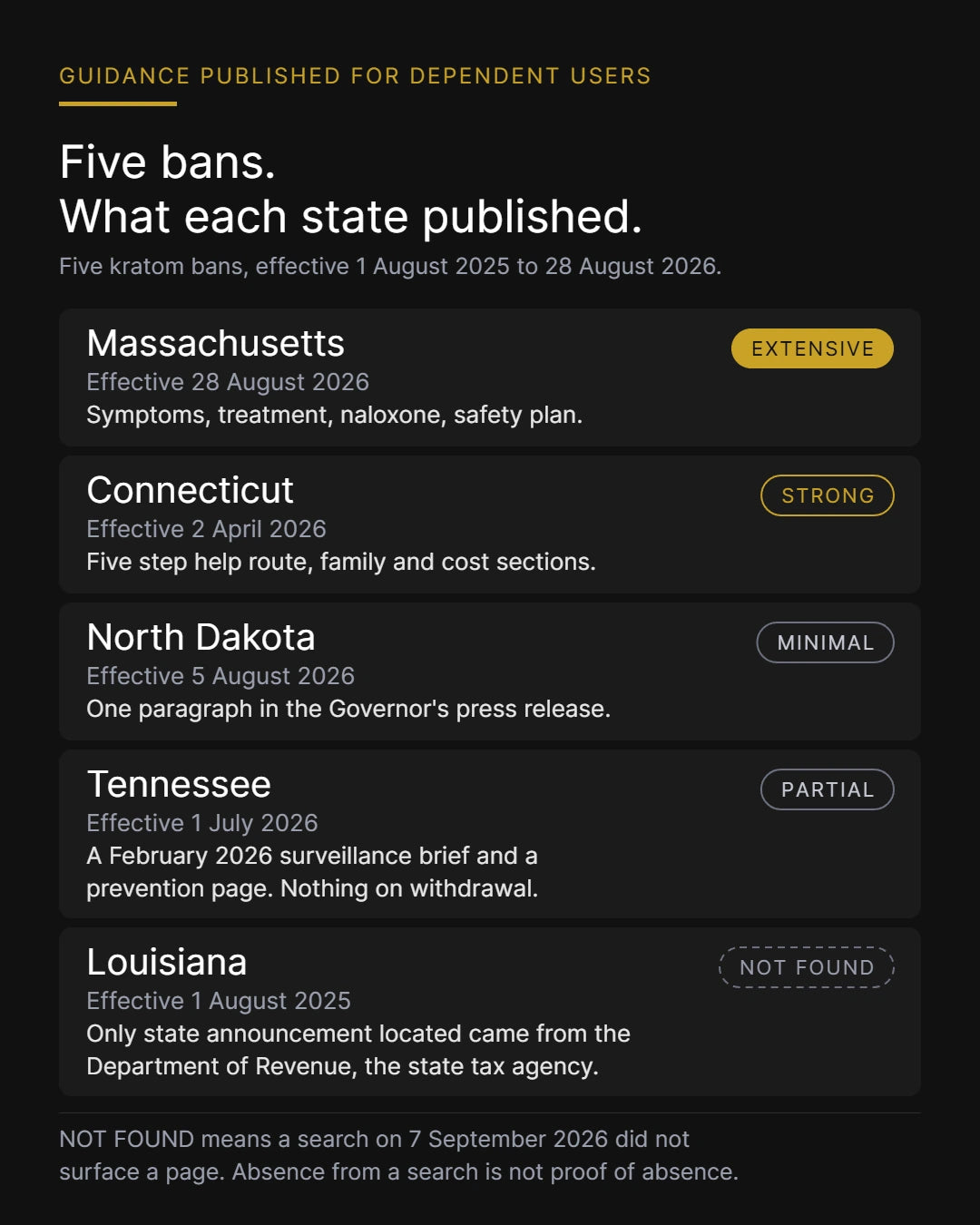
The caveat on that last row is not a formality, and Tennessee is the proof. Send me the Louisiana page I missed and I will correct this column at the top of it, as I have just had to do.
Massachusetts and Connecticut, in their own words
The Massachusetts Department of Public Health kratom page does the thing I did not expect a state to do. It says out loud what its own order is about to cause:
The Department of Public Health (DPH) and the Bureau of Substance Addiction Services (BSAS) expects disruptions in the availability of all kratom products. These products can act like potent opioids. Therefore, people who regularly use these products are likely to experience opioid tolerance and withdrawal symptoms when they stop or reduce their use, including craving, nausea, diarrhea, muscle and head aches, sniffling, sneezing, sweating, and irritability. They should seek medical care and/or substance use treatment.
The same page states that naloxone should be administered as though a kratom overdose were an opioid overdose. That is a department planning for the consequence of its own instrument.
Connecticut's ban took effect five months earlier, and its Department of Mental Health and Addiction Services page carries what I think is the most useful sentence any government has published on this subject:
If you or someone you care about has been using kratom regularly and is now struggling, whether it is due to the recent changes in the law, physical dependence, or a desire to stop, you are not alone and help is available in Connecticut.
Read the middle clause again. Whether it is due to the recent changes in the law. Connecticut is the only one of the five that names its own ban as a reason a person might now need help, and it then does the practical work behind that sentence: a warning that regular users may face significant withdrawal, an instruction that medical supervision is strongly recommended, a flat direction not to stop abruptly without consulting a healthcare provider, and a five step route into treatment beginning with a number answered at three in the morning.
North Dakota's paragraph, Tennessee's omission, and Louisiana's tax agency
North Dakota did something, and it is owed the credit. The last paragraph of the Governor's announcement of 3 August 2026 reads:
Consumers who believe they may be addicted to kratom, 7-OH or other kratom derivatives and are concerned about recovery or withdrawal from the drugs may call or text the DHHS crisis lifeline at 988 or the information and referral helpline at 211.
One paragraph, at the foot of a release about scheduling and enforcement, straight after the one addressed to retailers. Retailers got three operational steps and the Board of Pharmacy to call. Dependent consumers got two three digit numbers. It is real, it is more than Louisiana managed, and it is a paragraph. That order was rescinded on 4 September 2026, though kratom remains banned in North Dakota.
Tennessee prohibited kratom from 1 July 2026, and it published. A February 2026 surveillance brief that predates the ban, and a prevention and overdose response page. Both carry treatment referral numbers. Neither addresses withdrawal management, and neither was published in response to the prohibition. Tennessee produced material about kratom users and nothing for the ones its own ban had just cut off. A more precise failure than silence.
Then Louisiana, which is why I wrote this. Its prohibition took effect on 1 August 2025 and the only state announcement I found is a Department of Revenue notice. It names the harms, listing liver toxicity, seizures and death. It names the law, Act 41 of the 2025 Regular Session, making it unlawful to knowingly or intentionally produce, manufacture, distribute, dispense or possess kratom, and it names the consequences, up to five years in prison and fines reaching fifty thousand dollars. Then it stops. No number, no treatment route, no acknowledgement that anyone in the state was dependent on 31 July 2025 and woke the next morning in possession of a controlled substance.
What the evidence under all of this actually supports
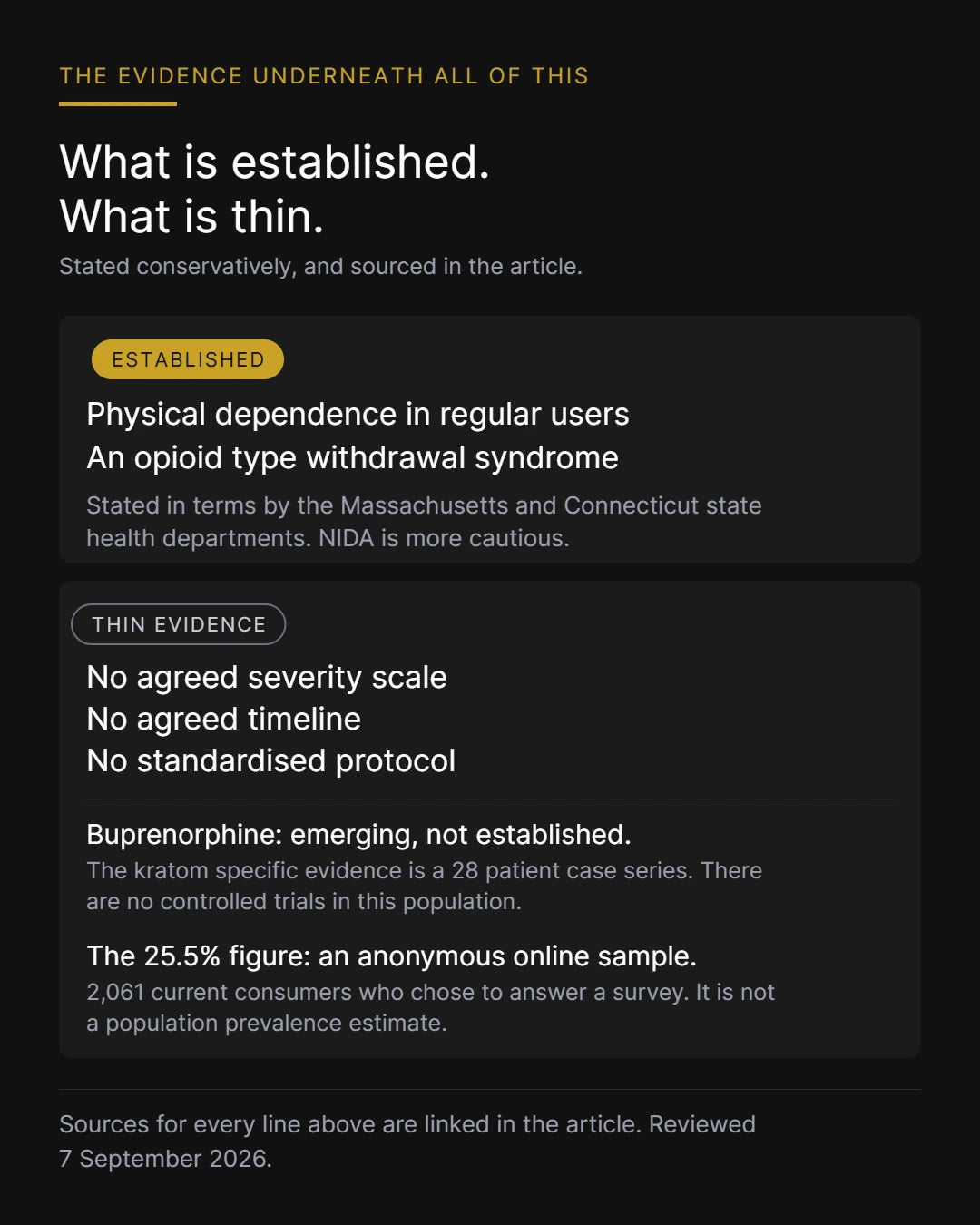
Physical dependence and an opioid-like withdrawal syndrome in regular users are established. Massachusetts says so, Connecticut says so, and no clinician I have read on the record disputes it. This industry should stop treating it as contested.
That is two health departments, not the federal institute. NIDA is more cautious: it writes that studies suggest people "may experience mild to moderate withdrawal symptoms" when they stop regular use, and that more research is needed. I cite it for the treatment evidence, never for legal status and never as agreement that this is settled. The argument is worth more, not less, for carrying the hedge that cuts against it.
Everything downstream is thin. No agreed severity scale, no agreed timeline, no standardised protocol; the main systematic review, in the Journal of Psychoactive Drugs in 2019, rests substantially on case reports. Massachusetts writes that medications used for opioid use disorder, buprenorphine among them, have been found effective for kratom use disorder, and the citation under that sentence is Broyan and colleagues in 2022, a case series of twenty eight patients. Smith, Epstein and Weiss, in Current Psychiatry Reports in 2024, put it plainly: most clinicians reach for buprenorphine although there are no controlled studies showing it is safe or efficacious in this patient population. NIDA's own page says there are currently no approved medical therapies for these conditions.
Hold all of it together. Clinicians reach for buprenorphine, a health department says it has been found effective, and the kratom specific evidence is a twenty eight patient case series. The real evidence base is for opioid use disorder. That is emerging, not established, and a person deciding about their own body deserves to know which of the two they are being offered.
One more number, because it is about to be misquoted at you. Hill and colleagues, in the Journal of Addiction Medicine in 2024, surveyed 2,061 current kratom consumers online and found 25.5 per cent met adapted DSM-5 criteria for kratom use disorder, most often through tolerance and withdrawal. That is an anonymous online convenience sample of current consumers. It is not a population prevalence estimate and cannot be turned into one, so anybody telling you one in four kratom users are addicted has either not read the paper or is counting on you not having read it.
And the one finding here that cuts in my favour, which is why I am printing it. JAMA Network Open, 2 March 2026: kratom mentions in hospitalisations rose 14.9 per cent annually across 2017 to 2024, the figure the coverage carried. Inside it, the rise sat in 2017 to 2020, the 2020 to 2024 change was not statistically significant, and emergency department mentions did not rise significantly at all. Discount accordingly; it is the one number here that helps me.
The displacement worry, and the only observation anybody has
A version of this argument circulating in the trade says bans push dependent people to fentanyl. I am not going to write that sentence. No study shows it, and a claim that convenient needs better evidence than a claim that is merely true.
What exists is two named clinicians expressing a fear. Dr Jennifer Michaels, medical director of The Brien Center in the Berkshires, told the Berkshire Eagle on 25 August 2026, in Izzy Bryars's report, that "we may end up unintentionally putting them at risk". Her stated worry was patients turning to "street opioid pills or heroin or fentanyl". Julia MacDonald, who directs Living in Recovery in Pittsfield, told the same paper that "ripping it out from under them" is not necessarily the most humane approach. The Eagle is paywalled. Its own framing, in full: "But while public health officials generally agree that kratom is dangerous and addictive, some have expressed concern that cutting access without a path to treatment could push some users toward other illicit narcotics." Could. Some. Those are the paper's words, the first clause included.
Now the counter-fact that almost nobody running the displacement argument is carrying. About nine days after North Dakota's prohibition took effect, KXNET in Bismarck reported that the ban had not led to a spike or increase in people seeking treatment for kratom use, while staffers at Heartview believed that could change if the drug were permanently banned. Nine days is a short window, one provider is a small sample, and their caveat belongs attached. It is also the only post-ban observation of its kind anywhere, and running the warning without it is cherry-picking.
If I quote Michaels I carry the rest of what she said, because she is reachable by any journalist and because quoting the convenient half of a doctor is what this industry gets caught doing. In the same piece she said the gas station where she buys her coffee has turned into what she called "a kratom store". She described a man in his seventies who got hooked because the product was "so ubiquitous". She said her kratom patients are "almost universally" polysubstance. And she said users rationalise their use on the grounds that the plant is natural, which is a marketing line, and the marketing is ours.
Everything above this line is reporting, sourced and linked, with the negative findings labelled as searches that came back empty. Everything below it is my opinion, and you should read it as one operator's argument rather than as a description of the record.
Opinion: I have already written the easy half of this
On 18 August 2026, in the column on where kratom is illegal, I wrote that an industry which has spent years insisting dependence is not a real problem does not get to act surprised when a health department starts planning for withdrawal. I stand behind it.
It was also the easy half. It cost nothing, because a claim about a general attitude cannot be checked. The five rows in that table can be. Two states did the work and the other three put a dependence producing product beyond the law without publishing a way off it. That is not an attitude. It is a gap with dates on it, thirteen months of it in one state.
Opinion: nobody in this trade asked for the transition page
Here is the part that should sting, and it is aimed at me as much as at anyone.
The trade press covered these bans. The trade bodies issued statements. Money moved into litigation. As far as I can establish, and I would be pleased to be corrected, not one of us went to Louisiana in August 2025, or Tennessee in July 2026, and asked the health department to put up a page for dependent consumers before the shelves emptied. It would have cost nothing, and it would have been the most credible thing this industry has ever asked a regulator for, because a page telling people how to stop using your product cannot be read as self-interest.
We did not ask. I did not ask. The reason is not laziness. Asking a state to publish withdrawal guidance means conceding on the record that regular use of our product produces a withdrawal worth publishing guidance about, and for years the trade position has been that it does not. The ask was unavailable to us, not because nobody thought of it, but because we had spent a decade making it impossible to say.
Opinion: the trap, and I am standing in it
Now the thing I would most like to leave out.
The argument I have just made concedes that kratom produces opioid-like dependence severe enough that a state ought to plan medical support around removing it. I mean that concession. The trade's litigation posture against emergency scheduling runs the other way, arguing the product is not dangerous enough to be treated as an imminent hazard. Both are being made in the same news cycle, sometimes by the same organisations, and they undercut each other.
A state lawyer will put them side by side, because it is the easiest cross-examination available. Your own industry says removing this product requires a clinical transition plan, and also says it is not hazardous enough to warrant emergency action. Pick one.
The two are not strictly irreconcilable. You can believe a product creates real dependence and also believe a particular emergency instrument was the wrong tool, or drawn too broadly, or skipped a step its own statute required. Those positions are compatible, but only if you say the first part out loud and keep saying it, on your own labels and in the rooms where it costs you something, rather than reaching for it in the week it is useful and putting it away again in the week it is not.
That is what makes it a trap rather than a debating point. A column that runs the withdrawal argument without noticing the contradiction is doing the thing it criticises. I am running the withdrawal argument. So I have named it, I am not pretending the concession is costless, and if you see me or anybody in this trade argue next month that dependence is overstated, hold this column up.
Opinion: what I would actually do with this
If you sell, start with your own label rather than a campaign. Say that regular consistent use produces physical dependence, and that stopping after a long run can be rough enough to want a clinician alongside it. If that costs you conversions it is still true, and Massachusetts published it on a government website in August without asking your permission.
Second, make the transition page a standing ask. Every time a state moves, the same letter goes out that day: here is a draft consumer page, here is the helpline that already exists in your state, publish it before the effective date. Send it to the health department rather than the agency running the ban, because the two are often not the same office and Louisiana is the proof.
Third, if your trade body is fundraising for litigation, ask what share of that budget has reached anything a dependent consumer could use. I suspect the answer is zero, and I suspect it because I have never asked either.
And if you are the person this column is actually about, someone who uses this every day in a state that has just taken it away, I have one thing to say and then I am going to stop talking. The answer is not a bigger cupboard and it is not buying ahead of the date. Call the number in the red box at the top of this page, or ring your own doctor, and tell them plainly how much and for how long. Connecticut's guidance says not to stop abruptly without a clinician, and that guidance was written by people qualified to write it, which I am not.
I keep the state map and the bill tracker on the industry intel page, verified on a date. Journalists who want the documents behind this column can have them through the press page. If you have the Louisiana page I could not find, tell me and I will publish the correction with your name on it.
Two states got this right, and that is the part I keep returning to. Transition guidance is not hard or expensive or novel; Connecticut and Massachusetts have shown it is a web page and a phone number that already exists. Somebody has to decide it matters. In three of five states nobody did, and in none of the five did anybody from my side of this industry ask them to.
Disclaimer: This article summarises publicly available material as of 7 September 2026 and links to primary sources so you can check them. Statements that a state published nothing mean a search did not find anything, not that nothing exists. It is general commentary, not legal or medical advice, and no substitute for a clinician or for counsel in your jurisdiction. Sections marked as opinion are the author's own, and the author holds commercial interests in botanical brands. Nothing here is a health claim, and statements about botanical products have not been evaluated by the Food and Drug Administration.