

Ninety-One Days: The Only Kratom Repeal, and the Two Bans That Followed
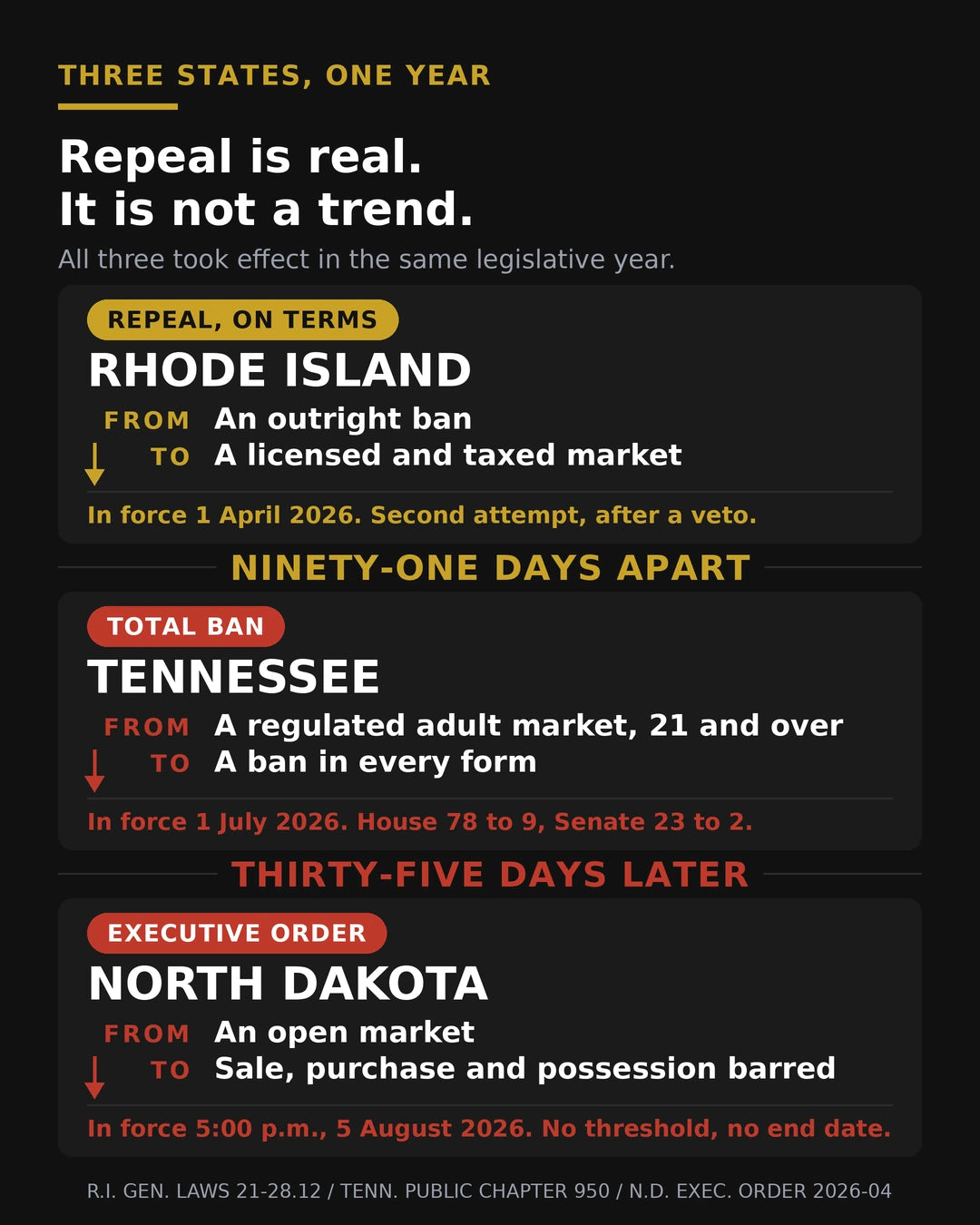
Kemal WhyteRhode Island repealed its kratom ban on 1 April 2026 and became the only state ever to reverse one. Ninety-one days later Tennessee banned kratom outright, reaching possession and not only sale. Five weeks after that, North Dakota banned it too, by executive order, in two days. One repeal and two bans, inside five months.
My industry has spent the months since April passing the first of those around as proof of something larger. It is not. Any version of this story that gives you only the first half is selling you something, and I have watched people I respect give exactly that version on panels.
Rhode Island. The Rhode Island Kratom Act, R.I. Gen. Laws chapter 21-28.12, took effect on 1 April 2026 and is the operative law there. Its history of section cites P.L. 2025, ch. 446 and ch. 447. No signature date appears here, because the coverage disagrees with itself and I have not read one at the source.
Tennessee. House Bill 1649, Matthew Davenport's Law, passed the House on 8 April 2026 by 78 ayes to 9 nays, passed the Senate on 16 April 2026 by 23 ayes to 2 nays, was signed by the Governor on 7 May 2026, became Public Chapter 950 on 15 May 2026, and took effect on 1 July 2026. Its penalty grades have now been read in the enacted text and are stated below.
North Dakota. Executive Order 2026-04, signed by Governor Kelly Armstrong on 3 August 2026, bars creating, manufacturing, delivering, distributing, selling, purchasing or possessing kratom or a kratom product from 5:00 p.m. on 5 August 2026. It carries no potency threshold and no fixed end date, and by its own terms it stays in force until rescinded or until the legislature acts. It is in force as I write. A separate Board of Pharmacy emergency rule, NDAC 61-13-01-03, took effect at the same moment and works differently, placing five named alkaloids in Schedule I on a threshold basis. A special session convenes on 2 September 2026 to consider a permanent framework, and no end date for it has been published. I have read the order itself rather than the coverage of it, which matters here, and the last section of this piece explains why.
Federal. Three documents, routinely conflated. The Drug Enforcement Administration filed a notice of intent on 6 July 2026, at 91 FR 40917, proposing to place 7-hydroxymitragynine above a specified threshold into Schedule I. That is still a proposal, no order has published under it, and it carries no comment period of its own. A separate DEA temporary scheduling order took effect on 26 August 2026, at 91 FR 54948, running to 26 August 2028, and reaches three named derivatives, mitragynine pseudoindoxyl, MGM-15 and MGM-16. That one sets no threshold and no minimum quantity at all. A third document, a Department of Health and Human Services request for information at 91 FR 41049, is taking comments until 10 September 2026. That deadline belongs to the request for information. It has been widely attached to the DEA notice instead, including in an earlier version of this box, and it does not belong there.
Reviewed 27 August 2026. Next review 11 September 2026, or the day North Dakota's special session concludes, whichever comes first.
A word about who is writing this. I hold commercial interests in botanical brands, some of which sell kratom, so I am not neutral and you should not read me as neutral. This site sells nothing. No products, no cart, no affiliate links. That is why the argument below is here and not on one of my stores.
What Rhode Island actually put on the books
The instrument is chapter 21-28.12 of the Rhode Island General Laws, The Rhode Island Kratom Act. Section 21-28.12-3 decides what may be sold, and it reads as a prohibition list. A person shall not prepare, distribute, sell, possess or advertise anything on it.
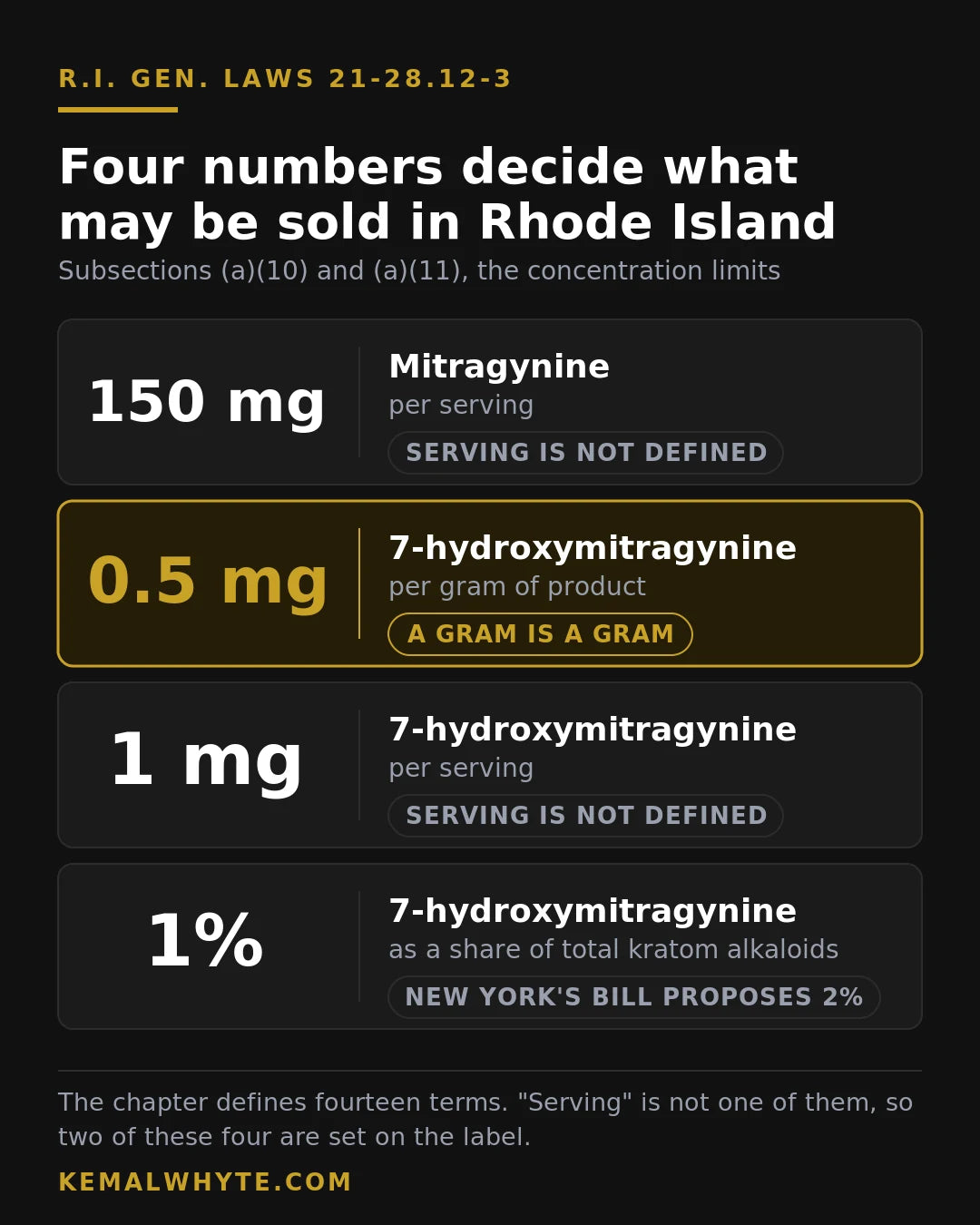
Four numbers sit inside that list. Under subsections (a)(10) and (a)(11), a kratom product is prohibited if it contains more than 150 mg of mitragynine per serving, more than 0.5 mg of 7-hydroxymitragynine per gram, more than 1 mg of 7-hydroxymitragynine per serving, or more than one percent of 7-hydroxymitragynine measured as a percentage of total kratom alkaloids.
Read that last one twice. One percent. New York's bill, the one this trade has argued about all summer, proposes two percent of total alkaloids. Rhode Island, the state everybody cites as the win, wrote the number at half of that.
The rest of the section is not softer. Subsection (a)(5) bans synthetic alkaloids flat, with no threshold underneath it. Subsection (a)(1) prohibits any kratom product that is a conventional food or beverage, or labelled as one, which disposes of a whole product format before a milligram gets measured. Subsection (a)(7) bans anything combustible or intended for vaporization, aerosolization or injection, and (a)(8) anything mimicking a candy product or packaged so as to appeal to people under twenty-one.
Then the operational load. Heavy metals capped in parts per million at arsenic under 2, cadmium under 0.82, lead under 1.2, mercury under 0.4. Residual solvents no higher than U.S. Pharmacopeia 467 allows. Child-resistant packaging to the 16 C.F.R. 1700.15(b) standard. A mandatory label carrying habit-forming, pregnancy and medication-interaction warnings, the FDA disclaimer, the mitragynine and 7-OH figures per serving and in total, and the manufacturer's physical address, which the statute says may not be a post office box.
Retail sale is limited to a licensed retailer sourcing from a licensed manufacturer, importer or distributor, and anything outside the section is contraband. The chapter then provides for confiscation, penalties, a hearing right, an appeal to district court, licences across four tiers of the supply chain, taxation, and a restricted receipt account.
That is the repeal. Not a liberalisation. A licence, a tax and a spec sheet, and the state kept the power to seize your stock if you miss the spec.
The second attempt, and the thing that actually moved it
Bill H5565A was sponsored by Speaker Pro Tempore Brian Patrick Kennedy, a Westerly Democrat, with a Senate companion, S0792, carried by Senator Hanna Gallo of Cranston. The Rhode Island Current reported on 29 May 2025 that the House passed it 40 to 23. That was not the first attempt. A version had already cleared both chambers in June 2024, and Governor Dan McKee vetoed it, citing regulatory confusion and the advice of state health officials.
So what changed?
Money. The same reporting says the 2025 bill added a licensing and tax mechanism, in coordination with the Department of Revenue, that had been absent the year before. Kennedy said it out loud on the floor, and I would rather quote him than paraphrase him: "We're looking for new sources of revenue for the state of Rhode Island. This actually will provide us with a new source of revenue."
The bill grew to twenty-five pages. Industry advocates, the same reporting says, bristled at the length and feared Kennedy's redux had departed too far from industry goals. The text took input from the Rhode Island Department of Health and from the Department of Behavioral Healthcare, Developmental Disabilities and Hospitals.
Hold those two facts together, because the column turns on them. The version that failed was closer to what the industry wanted. The version that passed was the one the industry liked least.
Floor opposition was bipartisan. Representative Michelle McGaw, a Portsmouth Democrat, Representative Chris Paplauskas, a Cranston Republican, Representative Marie Hopkins, a Warwick Republican, and Independent Representative Jon Brien of Woonsocket all spoke against it. Hopkins reached for ephedra, sold as ma huang: "We don't need a repeat of that, and passing this bill will be a repeat of that." Brien put his finger on something my industry has never answered well. "You can't vape tutti-frutti," he said, "but you could buy some kratom at the gas station and get out in your car and take it right away."
I do not have a rebuttal to that one.
The word the statute forgot
Here is the part I have not seen anybody write about, and I have been looking.
Rhode Island's definitions section, 21-28.12-2, defines fourteen terms. Contraband kratom products. Distributor. Importer. Kratom extract. Licensed. Manufacturer. Place of business. Sale or sell. Synthesized material, and five more besides. It is a careful list and somebody clearly worked on it.
"Serving" is not on it.
Two of the four numeric limits are stated per serving: the 150 mg of mitragynine and the 1 mg of 7-OH. If the statute never says what a serving is, then in practice the manufacturer sets it on the label, and a per-serving ceiling becomes partly self-defined by the party it exists to constrain. I am not accusing anyone of drafting that gap on purpose. It looks like the ordinary result of a twenty-five page bill written under pressure by people with a veto to get around.
The limb that cannot be defined away is (a)(10)(ii): 0.5 mg of 7-hydroxymitragynine per gram. A gram is a gram. No label copy and no serving-size decision moves it, which makes it the line that actually bites on a concentrate, and it is the one the trade press has not been discussing.
Since I am asking others to check their numbers, here are mine. One of the brands I am involved in publishes a certificate for a pressed extract tablet recording 7-OH at 0.102 by weight percent. That is 1.02 mg per gram, a little over twice the Rhode Island ceiling, so under the only state law in America that has ever reversed a kratom ban that tablet is contraband, and no relabelling fixes it.
The same certificate carries a mitragynine figure sitting above the statute's 150 mg per serving line, and I will not use that one for effect, because it only fails if one tablet is one serving and the statute does not settle that. One clear failure, one conditional. Less dramatic than the version I could have written.
Four rulebooks, four answers, one tablet
Run that single certificate against the four tests in play and you get four different results.
| Rule | The test it applies | What the certificate reads |
|---|---|---|
| Federal notice of intent | More than 0.050% 7-OH by weight, or more than 1.00 mg in the article | 0.102% by weight. Captured |
| New York S8925A, passed, not signed | More than 2% of total alkaloids, or more than 1 mg per serving | 0.375% of total alkaloids, 0.727 mg. Clear on both |
| Rhode Island, first limb | More than 0.5 mg of 7-OH per gram | 1.02 mg per gram. Contraband |
| Rhode Island, second limb | More than 1% of total kratom alkaloids | 0.375%. Clear |
Same tablet, same laboratory report, four answers. The disagreement is not about the chemistry. It is about the denominator. Per gram of product, per serving as a label defines a serving, as a share of total alkaloids, as a percentage of total weight: those measure different things, and a certificate answering one tells you almost nothing about the others.
One more trap. Rhode Island's definition of "synthesized material" is broader than the federal one, reaching any alkaloid created by chemical synthesis or biosynthetic means, naming fermentation, recombinant and enzymatic techniques, and reaching any alkaloid exposed to processes conferring a structural change. The federal notice published on 6 July 2026 instead reaches plant material further processed into alternative dosage forms. Not the same test.
Ninety-one days later, Tennessee
House Bill 1649 is called Matthew Davenport's Law. It amends six titles of the Tennessee Code, and its subject classification is Criminal Offenses. The primary House sponsor was Representative Esther Helton-Haynes, a Republican, with a Senate companion, SB1656, and roughly sixty cosponsors, overwhelmingly Republican but including five Democrats.
The margins were not close. The legislative record for HB1649 shows the House passing it 78 to 9 on 8 April 2026, and the Senate 23 to 2 on 16 April 2026. The Governor signed on 7 May 2026, and it became Public Chapter 950 on 15 May 2026.
A small thing that matters more than it looks. Secondary coverage gives that Senate vote as 23 to 3. The record says 23 to 2, with four present and not voting. One vote, no difference to the outcome, but it is the kind of number that gets copied until it becomes what everyone knows, and my own operation has published two figures that went wrong that way.
Before this law, Tennessee Code section 39-17-452 permitted natural kratom to adults twenty-one and over. Tennessee did not go from nothing to prohibition. It went from a regulated adult market to a ban in every form, across powder, capsules, teas and extracts. Section 2 of the enacted text creates three offences and no more: knowing possession, knowing manufacture, delivery or sale, and knowing possession with intent to manufacture, deliver or sell.
On penalties I no longer have to hedge. I have read the enacted text. Knowing possession is a Class A misdemeanour. Knowing manufacture, delivery or sale, or possession with intent, is a Class C felony. A tier nobody reported: a Class B felony where the sale or delivery was to a minor from an adult at least two years older who knew. If the question is attached to a person, get a Tennessee lawyer to read it.
The direction is the point. Tennessee reaches the consumer, not only the seller, which makes it a categorically different law from anything Rhode Island wrote.
It is not only a prohibition. It is a testing mandate. Sections 4, 5 and 6 make medical examiners test decedents for kratom in suspected overdose autopsies, physicians ordering toxicology for suspected overdose or neonatal abstinence syndrome include kratom, and the labor commissioner add kratom to workplace drug testing. Tennessee is building the evidence base the next round of bans will cite.
Five weeks later, North Dakota, in two days
Tennessee took four months from filing to effect. North Dakota took two days.
Governor Kelly Armstrong signed Executive Order 2026-04 on 3 August 2026, announced alongside Attorney General Drew Wrigley. It took effect at 5:00 p.m. on 5 August. The operative clause is one sentence: a person may not knowingly or intentionally "create, manufacture, deliver, distribute, sell, purchase, or possess kratom or a kratom product."
Read what that reaches. Not a concentrate, not an isolate, not a threshold. The order defines kratom as any part of the plant containing mitragynine or 7-hydroxymitragynine, anything obtained by extraction of the leaf, and any derivative, analog or other preparation. There is no potency line underneath it. A bag of leaf powder sits inside that order on the same terms as a pressed tablet.
The order says why it went that broad, in its own recitals: "many kratom products currently available in North Dakota will not be affected by classifying 7-OH as a Schedule 1 controlled substance." The state looked at scheduling the compound, worked out it would leave most of the shelf standing, and closed the shelf instead. Whatever else that is, it is not a state that misunderstood the difference between the leaf and the isolate. It is a state that understood it and decided the distinction did not help.
Now the part worth sitting on, because it is this entire article in miniature.
Almost every report of this order says it runs for thirty days. I believed it too. One of my own posts published it. It is not in the order. The words thirty, expire and lapse do not appear in the document at all. What the order says is that the prohibition remains in effect "until rescinded or until such time as the conditions of N.D.C.C. section 37-17.1-05(3)(b) or (c) have been met."
Go to 37-17.1-05(3)(b) and thirty days does appear, conditionally: the emergency terminates thirty days after legislative management asks for a special session, if the governor does not call one. Armstrong called the session in the order itself. The condition that starts that clock never occurred. So there is no thirty-day clock. There is an order with no end date and a legislature convening on 2 September to decide what replaces it.
An entire trade, me included, repeated a number that came from a summary of a document rather than from the document. Same failure as the Senate vote count above, with a larger bill attached. If you are a distributor deciding whether to hold North Dakota stock through September, "expires in thirty days" and "no end date" are two different businesses.
One more, smaller, cutting the same way. The Governor's own press release says the order prohibits the sale, use and possession of kratom. Use is not in the operative clause. It sits in the recital describing the problem, not in the list of prohibited acts. Possession is banned, so use is foreclosed as a practical matter, but the release and the order do not say the same thing, and the release is what got quoted.
There is also a second instrument almost nobody separates from the first. The Board of Pharmacy placed five named alkaloids into Schedule I by emergency rule, NDAC 61-13-01-03, effective at the same moment, and that rule is threshold-based. The executive order is not. "North Dakota banned 7-OH" describes the rule and misses the order, and the order is the one that empties a shelf.
I would not bet on what the special session produces. The working group advanced two bills on 17 August, one regulating natural kratom on an age-twenty-one and labelling model and one scheduling synthetic derivatives, which is a narrower landing than the order. Anyone telling you the legislature is about to ratify a total ban is guessing, and so is anyone telling you it is about to reopen.
Opinion: how many states ban kratom? Name the document.
This section is opinion and labelled as such, though the arithmetic under it is not.
You will see a bare number in almost every article on this subject. Do not trust one, including from me. The Rhode Island Current's 29 May 2025 report described the bill as removing Rhode Island from a list of six states banning outright the sale and manufacture of kratom. Tennessee coverage from mid-2026 puts it at eight. The federal notice of intent published in 2026 lists nine states prohibiting 7-hydroxymitragynine. The New York sponsor's memorandum lists seven with 7-OH ban legislation.
Six, seven, eight, nine. Four counts, all defensible, none interchangeable, because they answer four different questions: which states ban sale and manufacture, which ban the plant outright, which prohibit one specific alkaloid, and which merely have a bill about it. A count with no document behind it is not a fact. It is a vibe with a digit on the front.
I would like the trade to stop printing the bare number. I do not expect it to.
Opinion: repeal is possible, and it is not a trend
This section and the two after it are opinion, each labelled. Take the documents above and reach a different conclusion if you like.
One state has reversed a kratom ban. One. It took two trips through the General Assembly, a governor's veto in between, a bill that tripled in complexity, sign-off from two state health agencies, and a revenue mechanism attractive enough that a Speaker Pro Tempore could stand on the floor and pitch it as a funding source. In the same twelve months, a state with a functioning legal adult market voted 78 to 9 and 23 to 2 to close it.
Those are not the margins of a legislature that feels conflicted.
So the honest read is not that the tide turned. One state found a narrow set of conditions under which reversal was possible: a senior legislator willing to carry it twice, a fiscal note the state wanted, and a rulebook strict enough that health officials would sign it. Nobody has replicated it. The pitch decks treating Rhode Island as the first of many are describing a sample size of one.
Opinion: we should have wanted this bill years ago
The uncomfortable part, which is the reason I bothered writing any of this.
Look again at what the industry objected to in Kennedy's second bill. Length. Twenty-five pages. Too far from industry goals. Now look at what those pages contain: a licensing regime, a tax, potency ceilings, heavy metal limits, solvent limits, child-resistant packaging, real labels with real addresses. Read as grievances, a burden. Read as a description of a functioning consumer category, the bare minimum, and most of it is what a competent trade association would have written for itself a decade ago.
We did not write it. We fought versions of it in one state after another, argued the thresholds down where we could, and told ourselves a looser bill was a better bill. What that bought was a market where the same tablet is legal in one state, contraband in another and captured by a federal notice in a third, and where a consumer cannot tell by looking. Tennessee's legislature looked at that market and voted 78 to 9. I do not think those facts are unrelated.
Rhode Island is the proof the trade both wanted and did not want. It proves reversal is achievable, and it proves what reversal costs. If the version that finally passed is the one the industry liked least, the conclusion is not that Rhode Island overreached. It is that our own preferred version was never going to pass anywhere, and we spent a decade defending it regardless.
I include myself. My brands sell into this market and benefited from the looser years.
Opinion: the honest counter-argument, and my answer
Somebody arguing in good faith will say I am doing something convenient. If the rulebook that passes is always the strict one, advocating for strictness costs me nothing and makes me sound principled. Fair hit, and it deserves a straight answer.
Strictness is not the variable I care about. Testability is. A rule written as a number on a certificate can be complied with, audited, argued in front of a hearing officer and appealed to a district court, and Rhode Island's chapter provides for all four. A rule written as a mood cannot. I would rather have 0.5 mg per gram than a general prohibition, not because I like the number, which is tight enough to disqualify products I have money in, but because a number is something a business can build against and a prohibition is something a business can only lose to.
There is a limit on that argument, and I would rather state it than let a reader catch it. The chapter is not self-executing on the page. Its definitions have a hole in them, and how it lands depends on how a department runs a licensing regime, which a statute alone will not tell you. Anyone with inventory riding on the answer should confirm it with the state.
The tightening started immediately
Rhode Island's law took effect on 1 April 2026. That same spring, the Rhode Island Current reported on 20 March 2026 that a Portsmouth representative wanted kratom locked up behind sales counters. That is not a betrayal of the deal. It is what happens in every regulated category: the first statute is a floor, and the amendments start arriving before the ink is dry.
So the useful question is not whether your catalogue clears the numbers as written. It is whether it would still clear them after two ordinary tightening cycles. Mine would not, in places, and I know that because I checked rather than because I assumed.
What I would actually do with this
If you sell in this category, pull one certificate for your best-selling SKU and work out its 7-OH content per gram. Not per serving. Per gram, because the per-serving figure moves when your label moves and the per-gram figure does not. If the answer is above 0.5, you know how a licensed state would treat that product, and you can act while it is still your decision.
If you advocate, stop leading with the number of banned states and lead with the mechanism. Rhode Island did not move because anyone was persuaded kratom is safe. It moved because a bill arrived with a licensing structure, a tax line and two health agencies' fingerprints on it. That is a template, and a more useful export than the headline.
If you write about this, carry all three or carry none of them. A piece that reports the repeal and omits the ban ninety-one days later is not reporting, and a piece that carries two of the three is the mistake I made in the first draft of this one. I had Rhode Island and Tennessee and I did not have North Dakota, which is a state that closed entirely while I was writing about whether states reopen. Gas station heroin is answered elsewhere.
And if you buy this stuff, where you live decides what is legal, not what a brand's website says.
I keep the state map and the bill tracker on the industry intel page, and that is where I would look first for where a given state has landed. My column on the North Dakota ban makes the mirror-image argument, that the concentrated end of the category was always going to bring the rest of it down. Journalists are welcome to the underlying documents and to me on the record, which is what the press page is for, and anybody in the trade who would rather compare notes than argue in public can reach me here.
If it is useful, the tracker page also takes an email address and sends the monthly brief, which is where a change like North Dakota's gets written up while it is still a decision rather than a fact. That is the whole offer. There is nothing to buy on this site.
This column will be wrong about something eventually, because the subject moves faster than anything I publish. When money or a person is attached to the decision, verify it with somebody qualified in that jurisdiction. Advice, not a disclaimer.
Disclaimer: This article summarises publicly reported developments as of the date shown above and links to primary sources so you can check them yourself. It is general commentary, not legal or medical advice, and not a substitute for a clinician or for counsel in your jurisdiction. Sections marked as opinion are the author's own, and the author holds commercial interests in botanical brands. Laws in this area change quickly and local rules may differ from state rules. Nothing here is a health claim, and statements about botanical products have not been evaluated by the Food and Drug Administration.